Is Mont Blanc safe?
Want to walk under Mont Blanc this season?You cannot book the summit itself on GetYourGuide, but you can book a local guide for a half-day hike facing it, the Aiguille du Midi, or the Mer de Glace. These are the tours worth comparing.
Compare the toursFour real hazards
I climbed Mont Blanc once, with a guide, and what struck me was how much of the day was planned around four things.
- Rockfall, mainly in the Grand Couloir below the Goûter hut.
- Altitude: the summit is at 4,805.59 m, and the air above 3,000 m is thin.
- Crevasses on the glacier above the Goûter hut, which is why you are roped.
- Weather: summer days often start clear and build storm clouds in the afternoon, and conditions can change in minutes.
None of these is a secret, and none is a reason to stay away. They are the reason the ascent takes the shape it does.
The Grand Couloir, crossed with care
The Grand Couloir, also called the Goûter couloir, is a gully about 100 m wide between the Tête Rousse and Goûter huts, crossed with a steel cable as protection. Stones come down it as the sun warms the face. Monitoring in 2019 found rockfall least frequent between 09:00 and 10:00 and most frequent between 18:00 and 20:00, while most climbers crossed between 10:00 and 14:00. Snow on the couloir does not make it safe by itself: melting snow loosens rock.
Guides start around 02:00, cross the Goûter couloir when it is quietest, rope up in small teams and set a firm turnaround time. On Mont Blanc, turning back is part of the plan, not a failure. Rope teams are limited to three people by the hut rules.
What the study found
The most careful work on the route is a 28-year study of the Grand Couloir, covering 1990 to 2017, led by the geographer Jacques Mourey and funded by the Petzl Foundation. It found an average of about 3.7 fatal accidents per summer on the normal route, among thousands of passages each season: 17,768 crossings of the couloir were counted in summer 2019 alone. Rockfall caused 29% of the accidents. The study’s main lesson is about timing, since many climbers crossed at the busiest and not the quietest hours. The details are in the 2022 scientific paper on the couloir. That is the reason guides plan the crossing so closely, and the reason I would not attempt it without one.
Altitude and acclimatisation
Acute mountain sickness can start above about 3,000 m: headache, nausea, fatigue. Going down relieves it. Good programmes include a night or two at altitude first, in a hut at 3,000–3,500 m or on a training peak, which is why a guided ascent takes four to six days. The timings are on how long Mont Blanc takes.
Do you need oxygen?
No. You don’t need bottled oxygen on Mont Blanc. The summit is far below the roughly 8,000 m at which bottled oxygen becomes standard. The thin air above 3,000 m can still cause headaches and fatigue, which is why acclimatisation matters more than any gadget.
Hot summers and route closures
In very hot, dry summers such as 2022 and August 2026, local authorities and the guiding companies have temporarily paused ascents of the normal route until conditions improve. In 2026 the Goûter and Tête Rousse huts closed from 11/12 to 26 August and reopened when conditions were back to seasonal norms. Reputable guides will move your date or switch to another objective. The months that suit the climb are on the best time for Mont Blanc, and why the turnaround hour matters is on the 2 pm rule.
Before any high outing, I check the Météo-France mountain forecast and ask the Office de Haute Montagne at the Maison de la Montagne in Chamonix. They give advice on routes, conditions and huts.
Going high without climbing
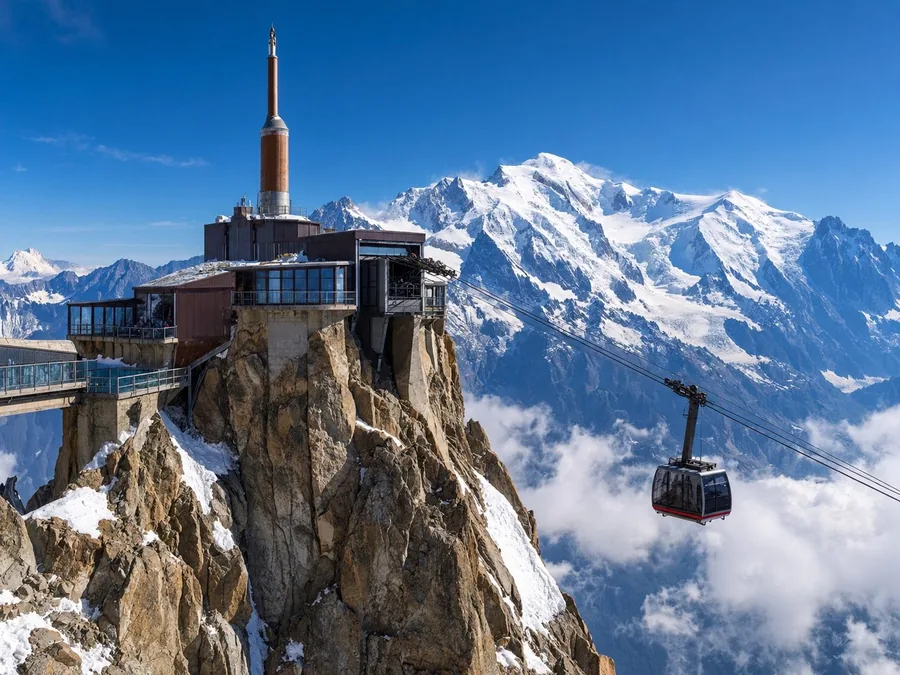
If you want to stand at altitude and look at the summit without taking on the climb, the Aiguille du Midi (3,842 m) is about 20 minutes by cable car from Chamonix. It is about 960 m lower than Mont Blanc, and no lift goes to Mont Blanc’s summit. This private half day (3 h 30) adds a guide at the top with a telescope and the history of mountaineering; it rates 5.0 on 10 reviews, and the cable car ticket is not included. More on the Aiguille du Midi.
For a first step on a glacier with a rope and an IFMGA guide, the Aiguilles Marbrées morning from Punta Helbronner is the one to look at; it is described on Mont Blanc as a beginner.
Frequently asked questions
Is Mont Blanc safe to climb?
Yes, when it is done the right way: with a certified mountain guide, acclimatisation, the right season and a turnaround time. The real hazards are rockfall, altitude, crevasses and storms, and guides plan around each of them.
Is it safe to climb Mont Blanc?
For a fit, trained climber with a guide, yes. Going alone without glacier experience is a different matter; see Mont Blanc without a guide.
What is the annual mortality rate for climbing Mont Blanc?
A 28-year study of the Grand Couloir (1990–2017) found an average of about 3.7 fatal accidents per summer on the normal route, among thousands of passages each season. Guides reduce the risk by crossing early and turning back on time.
Do you need oxygen to summit Mont Blanc?
No. At about 4,800 m the summit is far below the height where bottled oxygen becomes standard. Acclimatisation nights above 3,000 m are what matter, which is why guided programmes last four to six days.
Is rescue on Mont Blanc charged to climbers?
Mountain rescue in France by the PGHM remains a public service. Proposals to charge climbers have been floated but have not become law. Mountaineering insurance is still sensible.